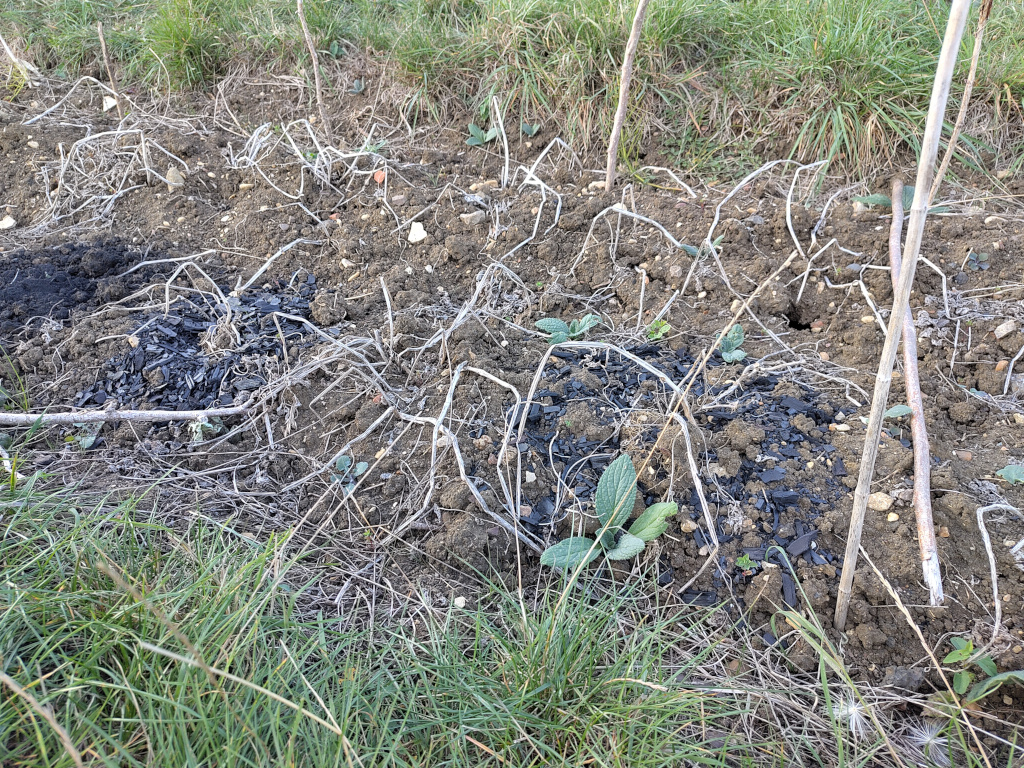
![Drawing on the earth. View from above of mark making using charcoal/biochar on soil used to grow a bed of potatoes in 2026 at Eastward Allotments, Cowley, Oxford. (Photo ref: IMG_20260903_072254[1])](https://andrewcreative.org/wp-content/uploads/2026/10/IMG_20260903_0722541-825x510.jpg)
You might recall in Residuals #4 and Residuals #7, I combined a crop trial of potatoes – a science practice – with the artistic practice of drawing. This year – 2026, I again conducted a crop trial of potatoes with charcoal/biochar. Initially, I undertook artistic research into marking the earth where the potatoes were grown with charcoal – which I describe here. Perhaps this is also the beginnings of Residuals #12?
This year I grew a crop trial of potatoes with and without biochar/charcoal. The purpose of the trial is – as previously – to see if biochar/charcoal can increase the yield or weight of potatoes produced by potato plants.
Residuals #7
In Residuals #7, the architecture of the crop trial is a long rectangular vegetable bed with pairs of potatoes planted opposite each other. This year, there are 23 potatoes planted with charcoal (the intervention crop) and 23 potatoes planted without biochar (the control crop).
When I and the unknown artist created Residuals #7, we had used a long piece of white drawing paper which was laid onto the bed with the crop trial or beside it. We allowed the potatoes and the biochar dug from the ground, to influence the outcome of our human drawing intervention creating a drawing performance and indeed a drawing artefact (charcoal drawing).
A new intervention for 2026

This year, I wanted to dispense with the drawing paper and to see if the earth itself could be marked and drawn upon directly. I conducted some artistic research using charcoal/biochar granules and charcoal powder.

You can see in the above photograph taken from above, four different marks made by dropping charcoal onto the earth around the dried-up stem of a potato plant.
- Mark 1 This was made by loading a container (jug) with charcoal powder which is then put on the earth upside down. This results in a hard edged circle of black charcoal on the earth. I then tried using a hand fork to create a swirl pattern believing that the fork would expose the earth and push the charcoal aside. However, this didn’t happen! The charcoal powder simply mixed with the earth, dulling its blackness.
- Mark 2 This was made by putting an upturned circular plant pot on the earth and dropping biochar granules onto it. The pot acts as a mask creating a hardish edge when removed. The granules don’t give the depth of black which results with charcoal powder – as above – but overall the mark making is acceptable and gives sufficient contrast.
- Mark 3 I created a kind of ‘piping bag’ using a rolled up A4 sheet and allowing the end of it to trail charcoal powder onto the earth, creating a ring shape on it. I then used a fork, much as in Mark 1, to try and create a swirl in the earth but much as before the powder was mixed with the soil and the saturation of the black charcoal dissipated.
- Mark 4 Using my had, I dropped charcoal granules onto the earth in a ring. The granules stayed on the surface and retained the saturation of the mark making. However, the granules are more textured than charcoal powder and so while the ring was evident, it didn’t have the definition – the hard edge – of the masking using in Mark 3.
It’s interesting to note that in the above descriptions then little attention is given to my embodied movement and much more attention given to the resulting image and artifact.
Further research
Using the investigation above then I concluded that a mask or stencil combined with charcoal powder may give the most clearly defined mark making on the surface of the earth.
You might notice from the photographs above, how each of the four investigation uses a dead potato stem at its centre. This is useful in digging up the potatoes as it helps to identify where each of the pairs of potatoes are located in the bed. In other words, there is both a functional and an aesthetic aspect to it.
Perhaps a stencil with a set of concentric rings will give some design variation in the mark making while also giving the function of identifying the location of each potato too? A kind of bullseye effect! That’s my next step in the investigation.