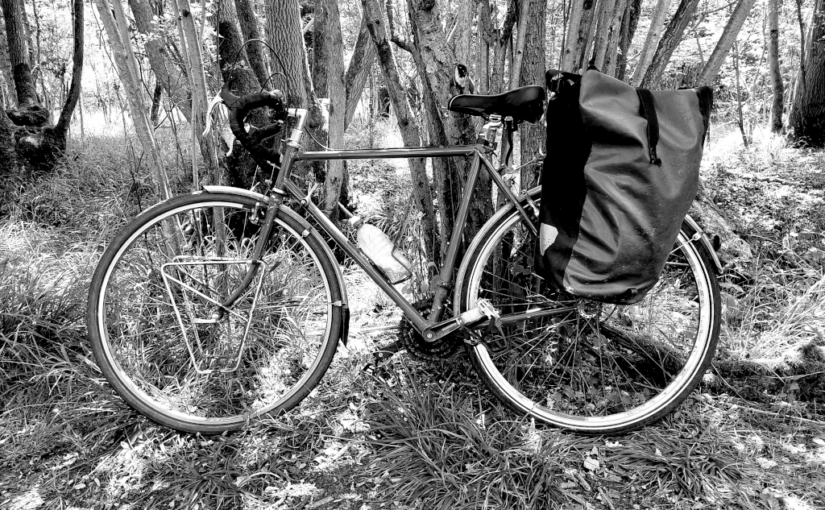
Let me show you a social sculpture. I made it with my bicycle.
I set off on my regular cycle ride – it’s in the countryside near where I live in Oxford. I climbed the hill at the beginning of the ride, and unfortunately the chain on my bicycle fell off. Oh dear, without the chain affixed properly then I can’t peddle and ride the bike!
To repair, it is easy but messy. Lift the chain with your fingers and put it back on the cogs – or sprockets as they are known – on the back wheel. Then the motion of peddling will propel you forward as it should.
As I bent over my cycle to fix the chain, my hands covered in thick black oil from the effort, a car stopped opposite me. The car drove up beside me, and the driver asked if I was okay. Did I want a lift with my bicycle to somewhere? That was very generous, and then he mentioned that he sees me in various villages and roads on my cycle ride – very frequently. All over the place!
Social construction
I thanked him, and explained that this is a regular ride for me. Infact, I’ve cycled this route several days each week for a number of years at about the same hour of each day too! I’d become a familiar sight to him no doubt, and indeed maybe this is why he stopped.
I declined the offer of being rescued, and I quickly put the chain back and repaired my bicycle. Riding my bicycle onward, I realised that I had been creating a social sculpture.
In riding the same route so frequently, I had created recognition in the people who live on my route or who regularly drive these back roads. There was a social connection, and this had a shape.
A sculpture
Perhaps it was the shape of the route which I regularly rode? Image a line drawn on a map showing this: that drawing is an illustration and it shows a sculpture.
But maybe the sculpture has a different shape? Perhaps it was more transactional and maybe it also had a time element to it? Like, flashing lights or stars winking on occasion when people notice me?
I could reveal the sculpture by distributing a postcard to the houses on my regular cycle route. I’d put a photograph of me on the front, and an explanation asking ‘Do you know this man? Would you reply with a comment. I have attached a stamp to the postcard for you to post a reply at no cost’. Hopefully, at least a few people might do it … and I would have a collection of postcards and comments to exhibit.
While the postcard artefacts and their reply would reveal the sculpture, they are not the sculpture. For surely, it is the social relations which exist between me and the inhabitants of the places through which I cycle? You can’t see it directly but you know it’s there, and that makes it real. But it’s not just my knowing: for when that man in the car recognised me and indeed stopped then it became concrete.
I felt it too, and I guess that he felt also something even if was only recognition and human connection. It was as if a cast was made, and the social relation became as real as a physical artefact.
But it’s not just my knowing:
for when that man in the car recognised me
and indeed stopped
then it became concrete.
Something real
The social sculpture which I describe exists as surely as a stone sculpture.
The tool which I used to make my social sculpture is not a chisel but my bicycle. By riding my bicycle – creating familiarity and human social connection, I created something as real as a sculptor chiselling stone.
You might also like
Notes
The practice of social sculpture is attributed the artist Joseph Beuys.
His work includes 7000 Oaks: ‘7000 Oaks – City Forestation Instead of City Administration‘ (German: 7000 Eichen – Stadtverwaldung statt Stadtverwaltung) which is considered a work of land art. It was first publicly presented in 1982 at documenta 7, and completed in 1987 after the artist had died.