
On 26 May, I visited the Warburg Reserve in Oxfordshire – a beech woodland which is managed by the wildlife charity BBOWT. It hosts a charcoal kiln in which wood is made into charcoal /wood biochar. I joined the staff and volunteers in charcoal making which included the log I’d cut into sections for my charcoal sculpture and a ready-made sculpture too.
Preparation

When I arrived at the charcoal kiln they’d been a lot of preparation. The site had been carefully laid out over many years. One of the people who made the charcoal, had been doing it for more than 15 years. While I was there, it was clear that a lot of knowledge and experience was being communicated – both by doing and indeed the discussion between the charcoal makers. As an observer, it was quite a fascinating process – both sociologically and in terms of the charcoal making practice too.
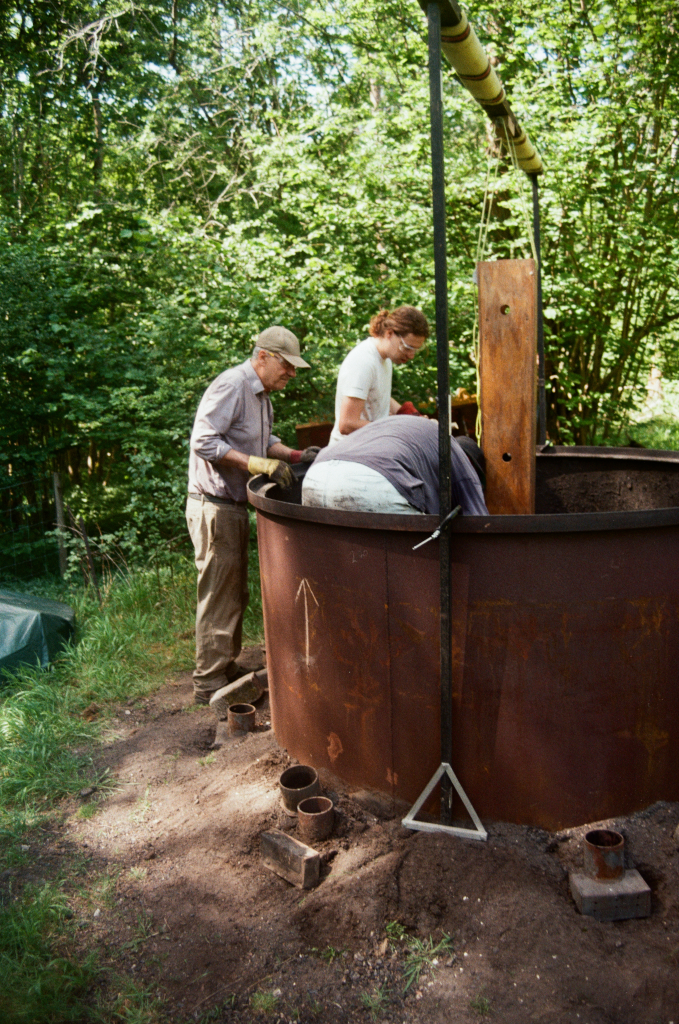
The charcoal was made at Warburg with a ring kiln – it’s a steel ring of metal that sits on the earth and which has a lid placed on the top when the kiln is lit. In this type of kiln, wood at the bottom of the kiln burns and creates heat – in the same chamber as the wood which turns into charcoal. The kiln is about two metres across and one metre tall. Another type of kiln used in this woodland situation is a ‘retort’. That design has a separate chamber for the wood – rather like an oven and it is heated from below. Literally, the wood is baked!
I was shown the woodland – hazel coppice – from where the wood was cut. It takes seven years to regrow from the cut tree although I recall that it takes about twice as long for hazel to become established from being planted as a sapling. Fencing and netting around the hazel coppice land was need to keep deer and other animals from eating the emerging shoots of hazel.


The cut wood was stored near the kiln so that it could be quickly and easily staked into the kiln. Busy hands pulled piles of cut branches from the store and carefully arranged it in a pattern around a chimney in the kiln’s centre.
Busy hands pulled piles of cut branches from the store and carefully arranged it in a pattern around a chimney in the kiln’s centre.
Actually, the chimney was a tall box section – a former – which was later removed to create a void.
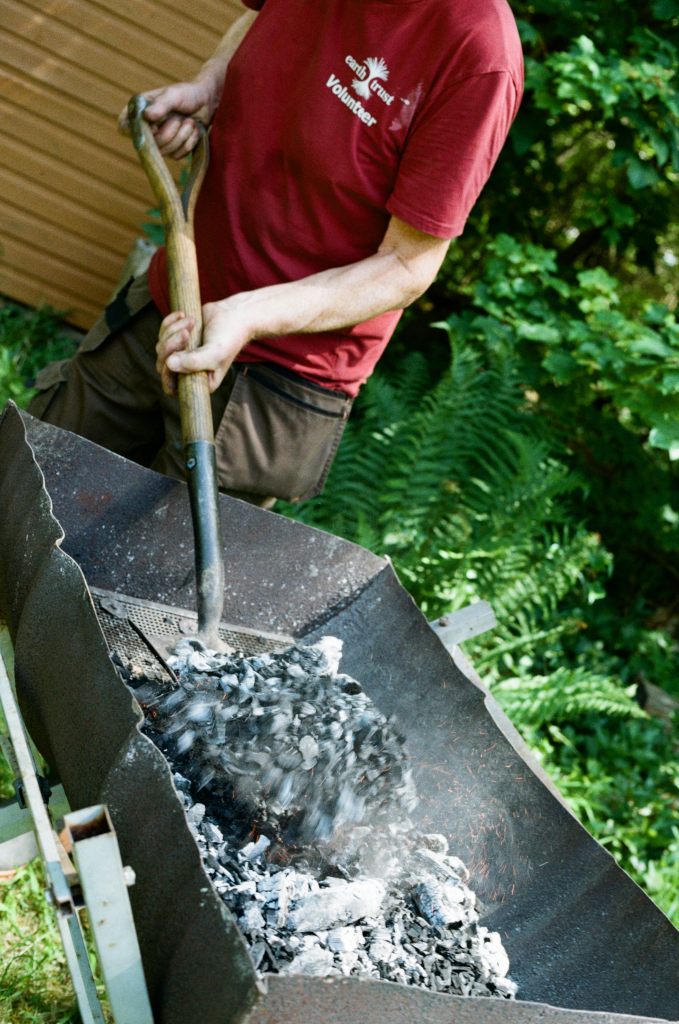
To light the kiln, charcoal was burned in a half metal drum, a spade full was then dug out and dropped into the chimney void of the full kiln, setting alight the chard wood and kindling material at its base, and then the lid was set atop the kiln creating an enclosed steel chamber.

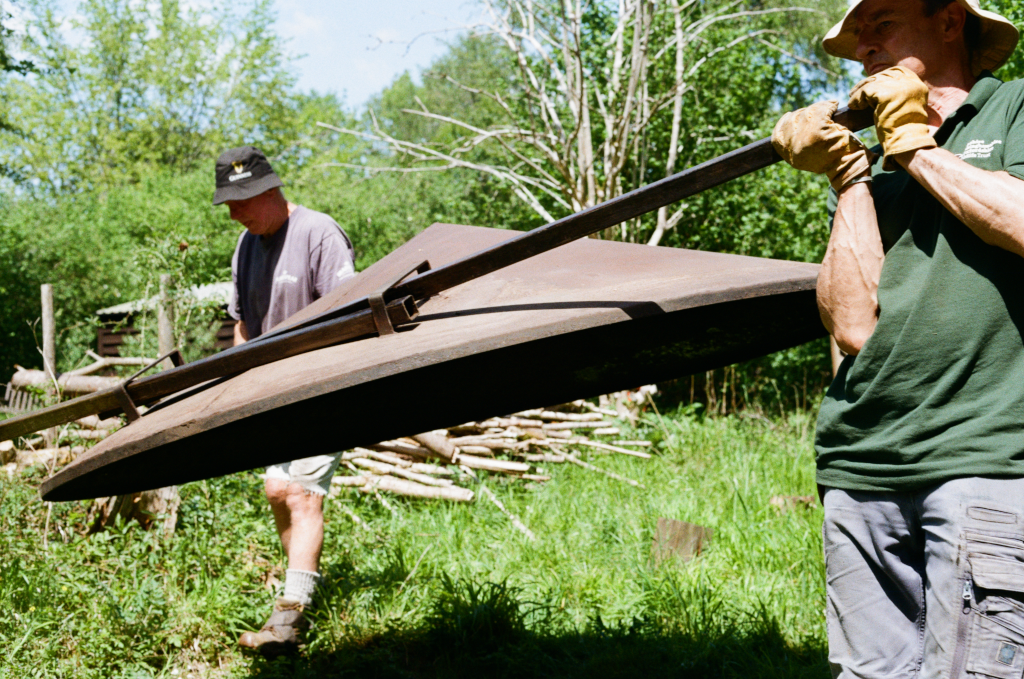
Initially, the kiln lid is a little raised as the fire sets in, and then once the smoke is abundant, the lid is closed and ash poured onto the top edge which seals it.
The baked potato approach!
To bake a potato, wrapping it in foil before putting it into a fire keeps it edible and unburnt! I wrapped my ready-made sculpture (dissembled flat pack wooden chair) in aluminium foil, enclosed it in a chicken wire sleeve and added a metal tube to assist with its rigidity. I wanted the wood to be evenly ‘cooked’ and to prevent it bending which might break the resultant charcoal chair. Of course, all these additions to the chair might make no difference at all, and the wood so fractured by firing that its unrecognisable. Let’s see what happens – it’s research!
The slices or sections of wooden log for my sculpture construction – actually red cedar wood I believe – were similarly treated as the ready-made sculpture. The wood was notably wet and unseasoned when I wrapped it in foil. Unlike the wooden chair which was probably several years old and a very dry wood.
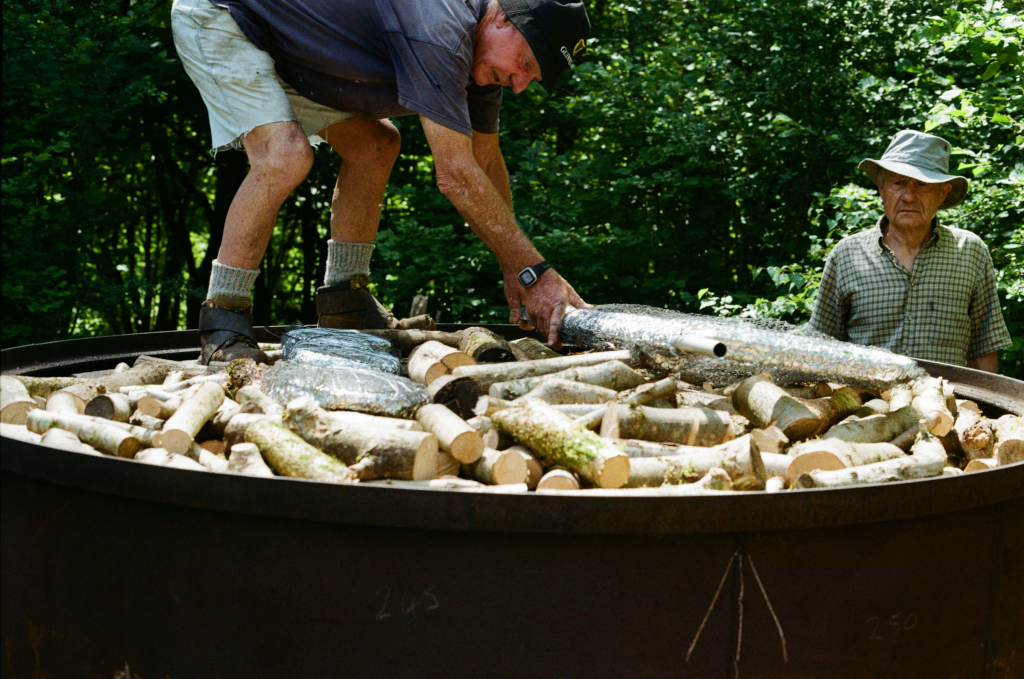
Both foil wrapped items were put at the top of the charcoal kiln. One nearer the centre and the other nearer the edge. We thought that there might be significant temperature differences between these two placements. The temperature of the kiln on its outside surface had been measured at 250-300 degrees centigrade: this is scratched onto the outside of the kiln. Not particularly hot by charcoal kiln standards.

Chimneys
There are a number of vents around the base of the kiln – some are stopped up and others opened to control the burning wood. Four chimneys were then placed onto the vents.
The ventilation can then be controlled by vents at the base of the kiln, both to facilitate even burning throughout and to control the rate of burn. I left the site at this point but later the vents would be closed. The charcoal is made and the process is complete; ready to be unloaded.
