
The residuals series of art works/performances used biochar granules that were re-purposed as artists charcoal for drawing. The series ran parallel to crop trials of potatoes with biochar – which acts as a plant fertiliser. The abstract for a scientific paper about these trials in 2024 is presented here which was developed with my collaborator Karl Wallendszus in 2025.
Below is the abstract for the paper which Karl and I are writing, and for which we have been seeking a publisher. In short, yes – biochar increases the potato yield but we’d need 160 trials for it to be statistically significant. ie we need to scale the programme!
If you are interested in publishing this paper in your journal or developing a research programme for a future trials then please contact Andrew!
Related posts on this website
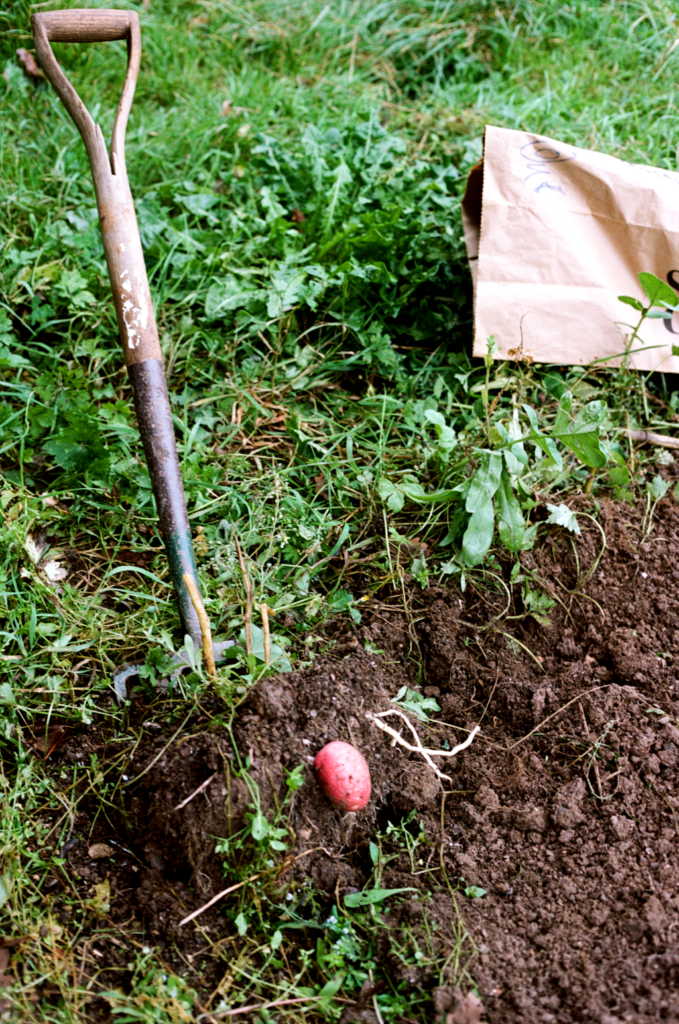
Residuals #7 at East Ward Allotments, Oxford, UK in August and September 2024
All posts about the Residuals series
Paper title: Co-created potato crop trials of biochar in community garden settings
Authors: Andrew Wood, Karl Wallendszus
Short abstract:
In 2024, crop trials of potatoes (Solanum tuberosum) with wood biochar were co-created with gardeners in community garden settings at Oxford and Dartington, UK. They were given an experimental design and biochar. The results show a non-significant increase in yield, and may inform a larger study.
Longer abstract:
Treating soil with biochar is a way of adding carbon. A number of studies have suggested it may also increase crop yields.
In 2024, ten crop trials were undertaken in community garden settings in the UK at Oxford and Dartington. Each trial comprised an intervention plot, enriched with biochar (charcoal from wood) and planted with potatoes (Solanum tuberosum), and a matching control plot, planted with the same number and variety of potatoes without biochar. These co-created trials allowed for differing cultivation practices and growing conditions.
In Oxford there were 6 participants and 10 crop trials at an allotment site. At Dartington, there was one trial in a student garden. A total of 300 potatoes were planted in all the trials. One trial failed to return any data and was excluded from the analysis.
Absolute weights of potatoes harvested from individual plots ranged from 0.7 to 21.0 kg. The primary outcome was the comparison of the log-transformed weights of potatoes harvested in the intervention compared to the control plots using a paired t-test. The difference (intervention – control) was 1.26 (P=0.09, 95% confidence interval 0.95 to 1.66), representing a point estimate of a 26% increased yield in the intervention group, but consistent with a 5% decrease to a 66% increase. This study is best regarded as a pilot study, since it would require about 160 plots, rather than 10, in each group to give 80% power to detect a 25% increase in yield.