I came across the idea of more-than-human-expression. To aid my understanding, I draw this diagram which seeks to reconcile the Residuals art series (drawing with charcoal) and crop trials of potato plants and charcoal (wood biochar) which I produced. The unifying concept of expression in human and non-human actors (potato plants) through charcoal, shows the material, practice and conceptual integration in an ontology.
Explanation!
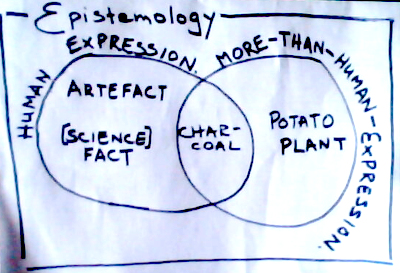
In two of the residuals art series (Residuals #4 and Residuals #7) then I combined the planting (starting a trial) or harvesting (stopping a trial) of potatoes with wood biochar (charcoal), and the production of a charcoal drawing. Or as we might say, I combined a performance of planting/harvesting crops trials – ‘science’ with an artistic production (a drawing/drawing performance) – ‘art’. Thus the idea of an Integrated Research Practice.
While this narrative produces an integration of artistic and scientific practice, it is a very anthropocentric interpretation. If we introduce then idea of more-then-human-expression then we can conceptualise the potato plant and its growth and production of potatoes (prodigy) in the same ontology: expression.
Biologists do talk of gene expression, and given that artistic production is also expression then the ontology of ‘expression’ is one which fits! In the above diagram, I’ve not written ‘gene expression’ but expression as the exact mechanics of expression are not particularly relevant to the conceptualisation.
Locating scientific and artistic practice in the ontology
Looking at the Venn diagram above then there is an intersection via charcoal. That makes sense as charcoal was used as both a drawing medium (in the Residuals art series) and as a plant fertilizer for the crop trails which I conducted in 2024 – with other people/gardeners. Charcoal is also know as wood biochar when used as a plant fertiliser and indeed, it was quite literally the same material for both scientific and artistic practices which I conducted.
I’ve place ‘artefact’ and ‘[science]fact’ in the diagram too. This is correct – a work of art – an artefact, is different to a fact in science. Certainly art – generally – has a physicality. But then again, so does science. Often science is documented and arguably, this is an artefact. A scientific paper is text. Text is textual. Indeed, when writing is on clay tablets – Cuneiform then the textual nature of it is very evident – you can feel it by touching it with you fingers and running then back and forth as if reading Braille.
So perhaps, artefact would – at least logically – suffice for both art and science practices?
Something’s missing
There’s probably quite a lot missing from this very simplistic Venn diagram but then again, it clarifies thought and so it’s a useful tool.
What about the social or societal (sociological) aspect of the artistic and scientific practices? That’s missing. Also, what about the environment or ecology (ecological) aspects of it? Those both seem important.
Perhaps I might ask you: where would you put these two concepts in the Venn diagram? Would you put them in the ‘human expression’ or the ‘more-than-human-expression’ circle/set? Or maybe both? In a forthcoming paper ‘The social construction of experimental design using tacit knowledge’ then I note the interplay between society and experimental design. Equally interesting is the idea of feedback mechanisms for one to influence the other, or to be present in some sort of symbiosis. It’s something to think about.
Finally, environment – where does that sit in the diagram? If it’s the natural environment then we must include that for both humans and more than humans – surely! But especially for plants. For humans too, there is the social environment – society, and we’ve already suggested that might sit in the ‘human expression’ set which is the left-hand circle/set.
A more inclusive ontology
So how about this?
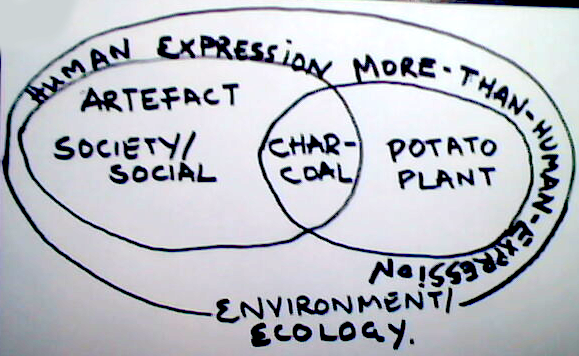
This includes all the concepts including society and environment! It’s a start!