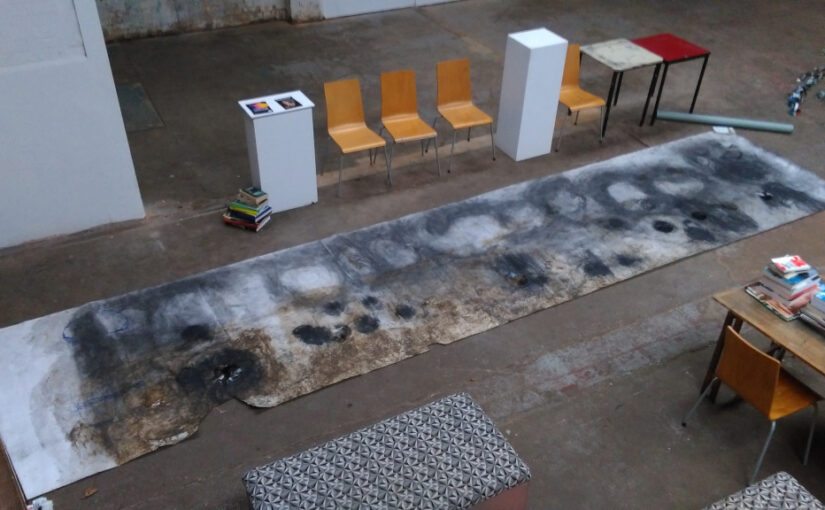
Residuals #7 was the longest of the Residuals series: an 8 metre long charcoal drawing which was intended to be suspended upside down so that you could move underneath it and experience the sensation of ‘flying over its surface’. In spring and summer 2025, Theo Hopkins – who is a designer and wood craftsman, worked with me in designing a wooden hanging frame to suspend the Residuals #7 drawing.
Prior to talking with Theo about possible designs for a Residuals #7 ‘hanging frame’, there was already a calico fabric stuck to the back of the drawing paper. This was partly to retain its integrity as there were plenty of tears in the paper. But the calico also had sleeves sewn into it by Unknown Artist/Performer. Wooden batons were threaded through the sleeves thus allowed the drawing to be lifted and hung securely upside down.
Clothes hanger
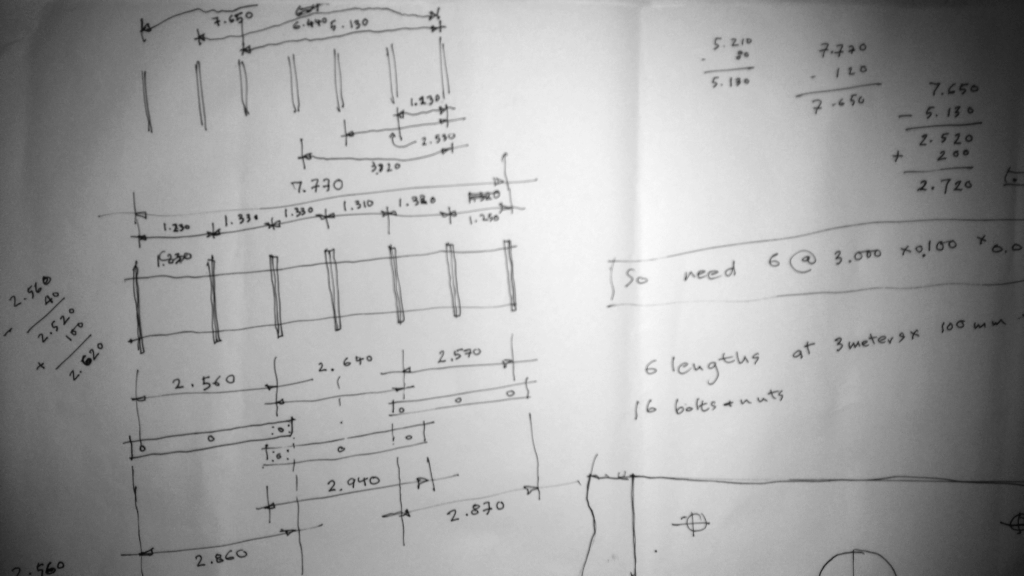
The initial design – version 1 – which Theo and I created in April 2025, was based on a frame much like is found on a clothes hanger used to dry washing at home. The particular design has a cord and pulleys which lift a frame with wet clothes hanging from it. Infact, Theo had made one of them for his house.
There are two 8 metre sides to the hanger into which the batons fit. Holes would need to be made in the lengths of wood, exactly where the batons and their calico sleeves were located. In this initial design, each of the sides was made of three pieces of wood bolted together.
When we laid the drawing out and measured the locations of the sleeves in the calico then we found they weren’t uniformly spaced. Also, since we measured the drawing as it lay on the grass outside then we were uncertain of the accuracy of our measurement. Perhaps there were other possibilities …
Another design!
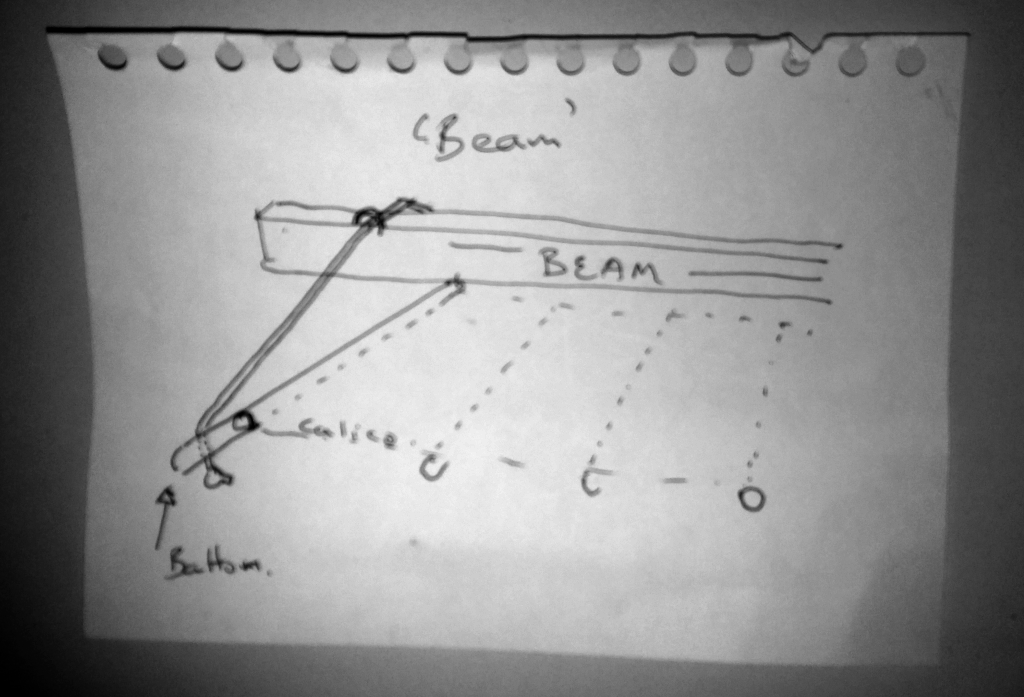
We settled on another design (version 2) which had a beam – like a spine or backbone, with ropes hanging from it – like ribs – and to which the batons holding the calico are attached. There was another advantage of this design, in that the ropes could be moved easily to ensure the correct positioning so that the calico had an even surface. Finally, if the spine were in parts, consisting of wooden sections bolted together – like vertebrae in a spine – then it could be stored more compactly … in my allotment shed!
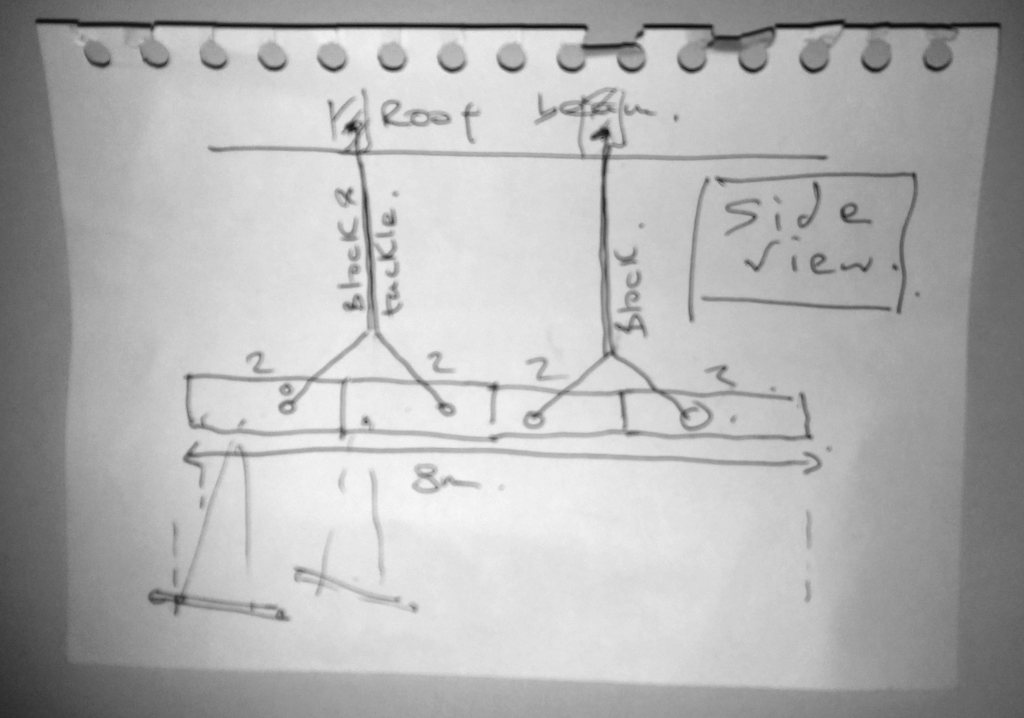
The material for the spine was to be plywood which can be ordered and cut to length. If there were four 2 meter sections then that would be the 8 metre length of the drawing. Also, if we overlapped three of the plywood sections then we could create a mortice and tenon like section that would hold together with good rigidity.
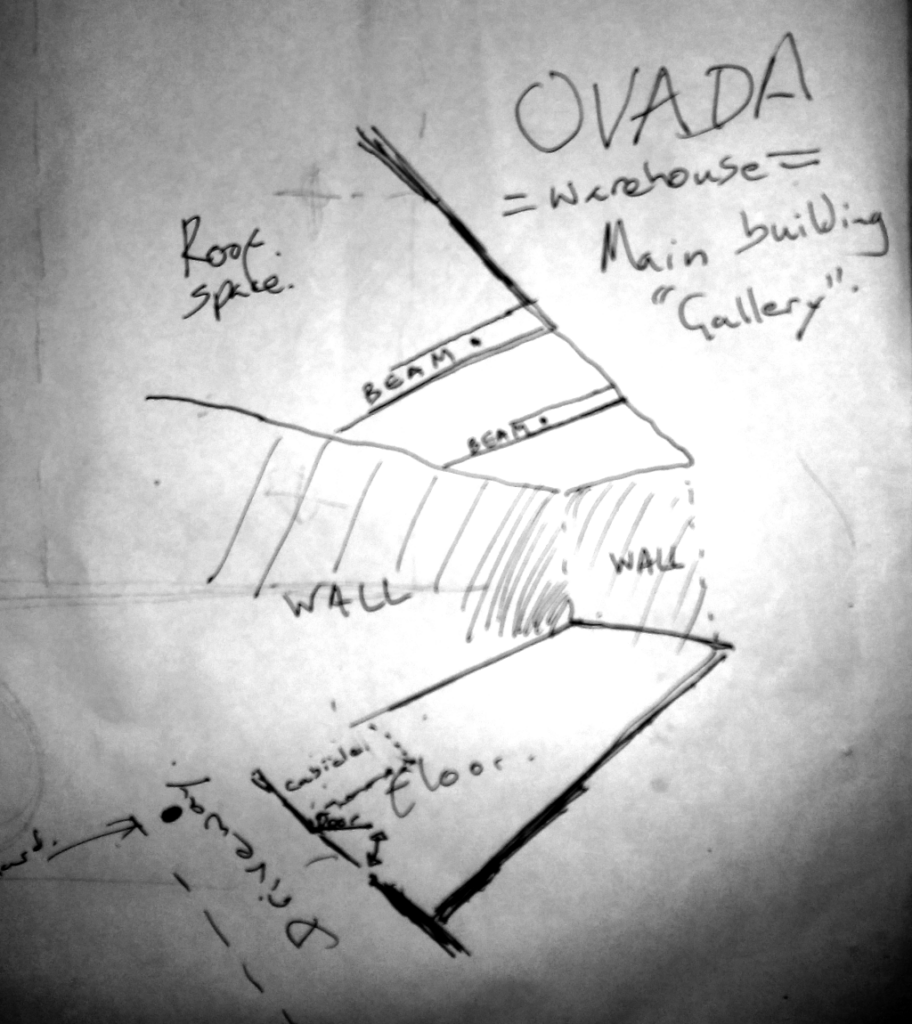
We’d envisaged that Residuals #7 would be suspended in a building with a high roof – much like the warehouse space at OVADA in Oxford where I’d had a residency. Theo and I visited to space together, to measure dimensions of rafters in the roof and to assess the suitability of our design for it.
Design version 3 – almost there!
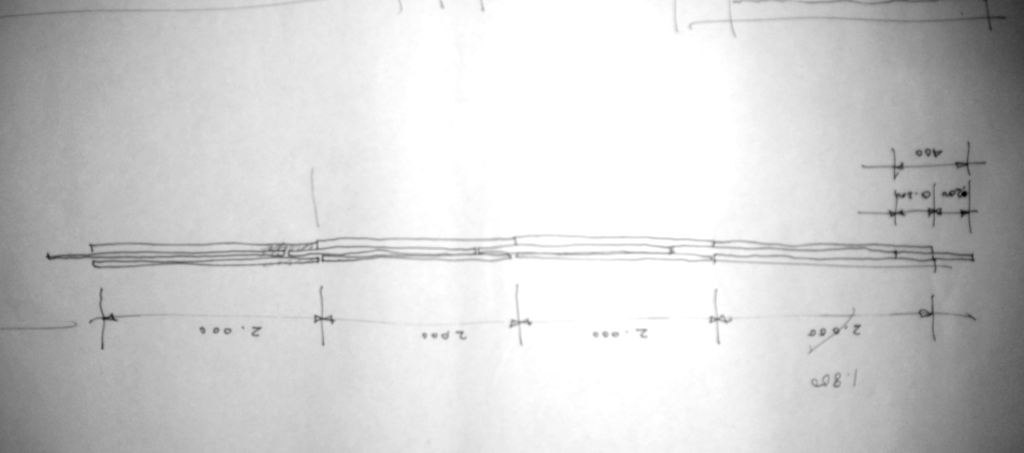
There was one short-coming which we identified with our ‘spine design’ – thankfully, before we started on its construction.
The ends of the spine or beam, need to be longer than the 8m drawing. This is because the ropes need to pull the outermost batons out to retain the tightness of the suspended drawing and fabric.
Otherwise, the batons will not be pulled out, and the calico material plus drawing will then be loose, falling-in and bowing. Infact, the whole length of the suspended drawing surface would be affected.
But if the spine – with its rope attachments – is longer than the drawing then it can effectively pull the calico material out and retain the calico taught and flat. Thus the drawing onto which its stuck, is also held flat too! Phew – glad we spotted that!
We therefore had a design with an extra 1 metre on each end of the spine, to allow the rope to be tensioned. This meant the spine is 10m and the 8m drawing hangs from it.
Final design – version 4!
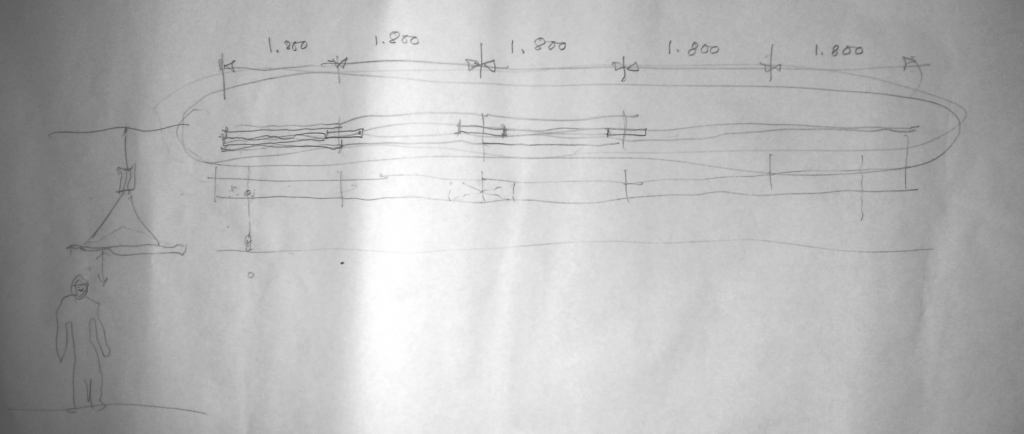
The final iteration of the design changed the cutting pattern of the plywood. So now, there were 5 sections which were 1.8m in length – giving a total length of 9m. This simplified the overall design – which gave a bit more elegance!
Not quite finished!
Writing in December 2025, the hanging frame for Residuals #7 hasn’t yet been built but we created a design which was an achievement.
Thank-you Theo Hopkins for all your creative input, calculations and pencil drawings.